
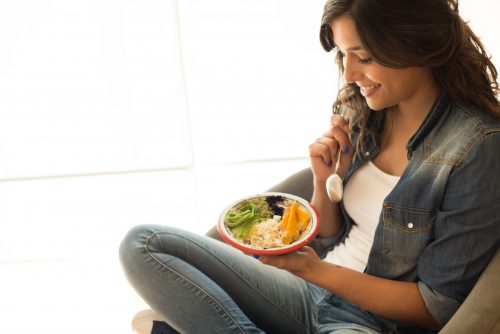
It’s no surprise that most people eat more food when offered larger portions, so portion control is important when trying to make eating-habit changes. Whatever your reason for wanting to learn portion control–weight management, intuitive eating, or cleaner eating–you can learn portion control!
A portion is the amount of food you put on your plate, while a serving is an exact amount of food. To get a better handle on what you’re eating, you can try the following things.
How to Better Portion Control
- Listen to hunger cues: eating for fun or for boredom can quickly result in over-eating. It’s important to pay attention to when you’re actually hungry as well as stop when you start to feel full. You should stop eating when you feel satisfied.
- Drink water before eating: Sometimes thirst can mask as hunger. If you drink a glass of water about 30 minutes before eating, it can aid in natural portion control and prevents over-eating.
- Don’t eat from the container or bag: food that’s packaged/bagged in large containers or packages can actually promote overeating. This is especially true for snacks like chips and candy. A way to avoid this is to pour a small amount onto a plate.
- Try to use the same (smallish!) dishes, so portion measurements are more consistent: by using the same plates or tuber ware to pack/eat food, you can consistently measure food portions more accurately. For example, vegetables should take up half the plate/container, proteins should take up about a quarter of the plate, and carbs should take up the last quarter.
- Eat slowly: when your eating, it takes your stomach a little while to send signals to your brain saying it’s full. When you eat slower, your brain will receive the signal to stop before you overeat.
- Separate mealtime and tv time: this one can be hard. Sometimes, our time to eat is our only down-time. We want to relax and be entertained for a little, but when we watch tv while eating, we get distracted. This distraction can cause us to overeat.
- Avoid takeout: another hard one! If you can’t avoid it, at least make it two meals. Portions from restaurants are typically double or more the correct portion.
- Ask for half a portion when eating out or automatically put half the meal aside: playing off the last point, if restaurants won’t serve in half sizes, automatically put half the meal aside. This will prevent over-eating.
Written by GUADS staff member Toni with contributions from www.mayoclinic.com and www.healthline.com
 The 10-Minute Morning Workout